Tuesday, February 12, 2013

Carnaval 2013


Today is the last day of our week-long Carnaval (Spanish spelling). Many people have today off as they did yesterday. It’s not an official government holiday but so many people take the day off the schools, post offices, banks, etc. are closed.

The initial Carnaval ceremony sets the tone for the week…the burning of bad mood...this year on Feb. 6. Daily parades follow, the first one being the traditional Desfile de Prescolar (Pre-School Parade). Floats of mystical beings from childhood are full of children in colorful costumes. They say put aside bad humor so everyone can enjoy the light, color, music and joy of Carnaval.

The last parade occurred yesterday…Batalla de Flores (Battle of the Flowers). I don’t know anything about it but Dee and I have promised ourselves that we will dive into the mayhem of Carnaval next year by getting a room at a hotel in downtown Merida to be in the thick of things.  The festivities come to a close tonight with the Burial of Juan—his widow cries and reads his tongue-in-cheek will which he leaves for the citizens and authorities of Merida.

Each out-lying community (Progreso, Chelem, Chuburna, etc.) puts on its own version of Carnaval. Unfortunately, we have not participated in any of them because we’re old. Explanation: Saturday we hustled to the plaza in Chuburna about 9:15 p.m. to watch the parade which was to begin at 9 p.m. (We’ve learned that nothing is punctual in Mexico.) While a stage had been set up, there were very few people around and no sign of a parade forming anywhere. After driving around and asking about when the parade would begin, and getting shoulder shrugs, we headed home. The next morning I asked Adam, a father of one of our English students, when the parade took place. “10:30,” he said. We have not yet learned well enough that time is not a driver of life here.

In our little celebration of Carnaval, we treated ourselves yesterday to a meal at a local restaurant, Los Delfines (The Dolphins), the most popular eatery in Chuburna. We were the only gringos there. One of the reasons for Delfines popularity is the quality and quantity of their botanas.

Botanas are appetizers/snacks that are served free at many restaurants. In most cases, as long as you order drinks (beer, wine, soda, cocktails) the botanas will keep coming. Given the number Delfines provides, one doesn’t have to even look at the menu to fill the gut.

Between the two cups of vegetable soup are the remains of two chaya patties. Chaya, the most nutritious green in the world, is combined with corn meal and fried as patties. Continuing left is a plate of fish ceviche, black bean dip, chips, kibee (patties made from garbanzo beans), brown bean dip, and octopus ceviche. Those and a couple of beers provide a great meal.

We eased off some of the botanas so we could enjoy platters of camaron diablo (spicy hot) and camaron empanzada (breaded and fried). As you can see there was no skimping on the shrimp. I couldn’t finish my diablo so we’ll have the rest on a salad tonight. All that (beers, botanas and meals for two) for about $17.


Delfines also provides a swimming pool, smart marketing and a delight 
for parents and children, alike. 
 

Monday, January 28, 2013

My Sister's Closet Fashion Show


This past Saturday the Chuburna Puerto APOYO Escolar Program hosted its third annual fashion show and boutique fundraiser.

The Mexican government requires that each child go to school until the 9th grade, but each student has to furnish all his/her school materials/supplies, sometimes even to the point of toilet paper. Families will turn themselves inside out in order to find the money to buy the required uniform, shoes, books, supplies and transportation.  Some families simply don’t have the money. The APOYO (apoyo means support in English) Program helps both types of families. APOYO Sponsors give between $125 to $200 a year, depending on a student’s grade level, to help the family with expenses. In return, each student has to maintain an 80 or better grade point average and write their sponsor a letter each year.

The program is managed by a volunteer committee of gringos, or in our case gringets. Any extra money raised via fundraisers is used to improve the schools. Last year’s funds were used to build a lunchroom at the primary school. This year the funds will go to create a pre-school facility.

My Sister’s Closet refers to the un-wanted clothes gringo women in these parts have dug out of their closets and donated to the cause.  The whole thing started three years ago when a fashionista who moved here wondered what she was going to do with all the clothes she hauled down here that she no longer wanted. Wise heads came up with the idea of a fashion show. That first show consisted almost entirely of her cast-offs. There were a lot of them.  Since she is not one to shop where most women shop her unwanteds were eagerly snatched up. Now women up and down the beach, and even some north of the border, donate to the show. (Friends and relatives bring the clothes down when they come down for the season.)  

This year’s show was held at a very lovely private home on the beach just around the corner from us. The beautifully landscaped yard provided a pretty backdrop as the models walked the “runway” of winding paths. The day was bright, sunny and full of light breezes.

While last year she served food, this year Dee modeled. And she performed like a pro. Below are pictures of the event.
 
 Dee on her initial presentation.


This is not Dee, just an overview of the garden.
 
A pro always knows where the most important
camera is.


OK. This requires some explanation. This year's theme was "In the Spirit of
Carnival."  Beginning Feb 6., Merida will host it's week-long celebration of Carnival,
the Spanish equivilent to Mardi Gras. A half million people will crowd the
streets for each daily parade, hundreds of live concerts, street performances,
food vendors and general wild-assed merry-making that people do around the world
before shutting down for Lent. So, the fashion show organizers decided to create
costumes that women can rent for Carnival. Luckily, Dee got to wear one of the
more modest ones. We're not sure what she's supposed to be but we're calling her
 Queen of Carnival. All hail the Queen!!    


Friday, December 21, 2012

Blessing of the fleet

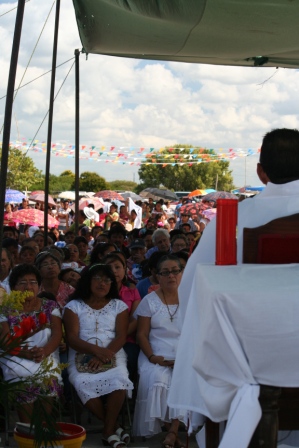
We attended the annual blessing of the fleet which took place at the Chuburna harbor. We understood very little of the ceremony but were impressed by the solemnity and the number of people who attended. 


Dona Eloisa, her daughter Margarita in the background
and a granddaughter. Mother and daughter are
English class students.


Oscar and Veronica, English class students,
 flanking their mother and sister.
 

Marieli and Lilliana, her mother, are English class students.


Jesus, alterboy and English student.


Thursday, December 20, 2012

Hummingbirds

For the last two years when we arrived here in October, a mother hummingbird has been building a nest on a hook on our porch. This year she was busily at it when we unlocked the front door.  A few days later she settled down into the quarter-sized nest to stare at us as we stared at her while sipping wine and gin and tonic. A week and half later we noticed she was leaving the nest for longer periods of time. Eventually, we saw tiny beaks sticking out of the nest. The next several weeks we watched the tiny, tiny things grow into tiny birds.


Mom taking a break.
 
 
See, Bro, this is how you do it.
 
 
Crap. You mean I gotta do this by myself?
 
 
This is the last time I'm feeding you. Get out of the house!
 
 
Yo, Ma. Lookit me!
 
All three of them continue to hang around, drinking from the feeder, dive-bombing us as we sit on the porch and attacking any other hummers that come close to "their" feeder. Dee talks to the mother: "Oh, what a pretty girl you are. Yes, you are." She whistles tunes to them. Tells them that we mean them no harm.
 
According to my reading they will head north across the Gulf sometime in late January/early February for a summer up north before returning here in September/October.

Revolution Day

On November 20th, Mexico commemorates the Revolution of 1910-20. Students from pre-school through high school participate in La Dia Desfiles--Day of Parades--in their respective communities. Here's how we celebrated here in Chuburna this year.

Chuburna falls under the political jurisdiction of the city of Progreso (pop. 55,000). Therefore, police protection is provided by the city, as is the police band when needed for important events in Chuburna.
 
Every school student, regardless of age or revolutionary nature, marches, or is semi-dragged through the streets.


Each school's color guard features the best students. Invariably, the color guards are all- female.  


This year's classroom lessons in nutrition were driven home to the parade-watchers. 
The instruments are made from cardboard, plastic bottles, and whatever else to kids can find to create what they need.


Each school stops in front of the city building to perform. 


The oldest students' routines would be an OSHA no-no in the U.S. On the pavement. Some with no shoes. No ground padding. Up in the air. Having fun while showing their agility.


 Note: No children were hurt while performing in this parade.
 
Xiomara (show-mara) is a high-school student that we support through the Apoyo Program.


Daniel, third from the right, hangs with his friends after the parade. He wants to be a doctor, an un-heard of desire without the support we give him through the Apoyo Program. 

 
Serafin, a student in the English class we help teach, enjoys an after-parade snack with his  revolutionary cousin.


Tuesday, November 20, 2012


Hacienda Xixim

Hacienda Xixim (she-sheem) is a bamboo plantation with a past that reaches back into the late 1500s, shortly after the Spanish conquered the Mayans. At its height, Xixim covered tens of thousands of acres and had more than 3,000 workers. (Xixim in Maya means “seashell.”)

Bob Gow
When Bob Gow, a Houston millionaire and friend and business partner of George H. W. Bush, first laid eyes on it more than 20 years ago, the once thriving henequen operation had closed, its buildings had fallen into disrepair and the land had shrunk to a little over 1,000 acres. He was driving around the countryside outside of the city of Muna, south of Merida, looking for a hacienda to buy. The insignificant dirt road he was on passed a trail leading into the low jungle. Curious about what was at the end of the trail, Bob turned onto it. At the end of the trail sat the remains of the factory, worker houses and a sizeable main house, all being swallowed by the surrounding forest.

(Historical note: The fiber of the henequen plant was manufactured into twine and rope, used in ship riggings, string, sacks, rugs, and many other things. It became known as sisal rope, named after the seaside town of Sisal, from where the rope was shipped. In the late 19th century, the henequen industry grew to unprecedented power in the Yucatan. At one point, Merida, Yucatan’s capitol, had more millionaires than any other city in the world. Hundreds of haciendas prospered until the advent of synthetic products after World War II and the cultivation of henequen in other parts of the world.)

Bob was told by the on-site caretaker that the hacienda was owned by three Merida women, all in their 90s. He rushed into the city, not wanting to waste a second given the owners’ ages and struck a deal.

Since owning the hacienda, Bob has raised bees and promoted the development of what is now a vibrant Yucatacan honey industry. He also created a fish farm, introducing tilapia to the local palette. Over 10 years ago he imported a thick-walled, extremely strong bamboo from India.  Today, Xixim creates furniture, fencing, buildings, palapas, picture frames, and charcoal from its bamboo. Some of it is shipped to the U.S. to three bicycle manufacturers who build bamboo bicycles.

Over the past 20+ years Bob has refurbished the main house and its out-buildings.  Now he has opened the hacienda to guests.

Dee and I, along with our neighbors Hank and Sunny, recently spent a day visiting Bob.
The bougainvillea-covered factory building.
The bamboo grows in clumps and is
harvested from the inside out.


Harvested bamboo.


A primative but effective method for creating charcoal.


A guest house and the pool.
A guest bedroom in the main house.

The front porch/veranda with Toby sniffing
 near tangerine trees.


Virtually all of Xixim's furniture was made
out of the hacienda's bamboo.